


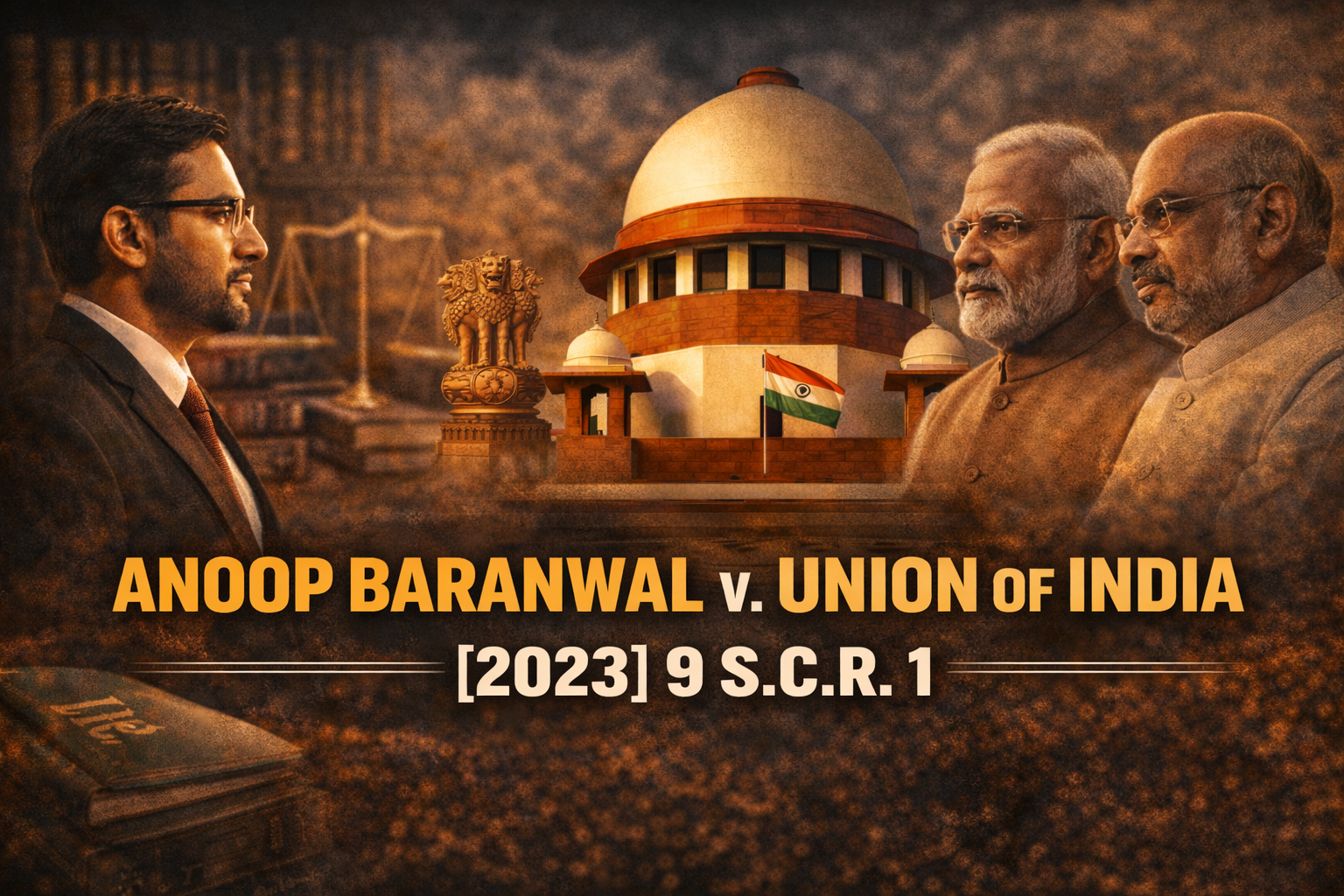
ANOOP BARANWAL V. UNION OF INDIA [2023] 9 S.C.R. 1:
DATE: 02/03/2023
COURT: Supreme Court of India
BENCH: Justice K.M. Joseph, Justice Ajay Rastogi, Justice Aniruddha Bose, Justice Hrishikesh Roy and Justice C.T. Ravikumar
OVERVIEW:
The case of Anoop Baranwal v. Union of India [2023] 9 S.C.R. 1 is a significant judgment by the Supreme Court of India that dealt with the process of appointing the Chief Election Commissioner (CEC) and Election Commissioners (ECs). The petitioner, Anoop Baranwal, challenged the existing procedure of appointment, arguing that it lacked transparency and independence, as the executive had sole discretion in making these appointments. The case questioned whether the absence of a collegium-like system for appointing election commissioners undermined the independence and impartiality of the Election Commission of India (ECI), which is crucial for free and fair elections. The Supreme Court, in its verdict, ruled that the appointment of the CEC and ECs must be made by a committee comprising the Prime Minister, the Leader of the Opposition (or the largest opposition party), and the Chief Justice of India (CJI), until the Parliament enacts a law governing the process. The Court held that this mechanism was necessary to ensure the independence of the ECI and to safeguard the democratic process from potential executive influence. This judgment marked a significant step toward strengthening the autonomy and impartiality of the Election Commission.
FACTS:
The case arose from concerns regarding the lack of transparency and independence in the appointment process of the Chief Election Commissioner (CEC) and Election Commissioners (ECs). The petitioner, Anoop Baranwal, filed a public interest litigation (PIL) before the Supreme Court, challenging the executive’s exclusive power to appoint the members of the Election Commission of India (ECI). The petitioner argued that the absence of a neutral and transparent appointment process compromised the independence and impartiality of the ECI, which is a constitutional body responsible for overseeing free and fair elections. The case highlighted how, under the existing framework, the appointments were made solely by the executive branch, raising concerns of potential bias and political influence. The petitioner contended that this practice violated the principles of free and fair elections guaranteed under Article 324 of the Indian Constitution, which mandates the ECI’s independence and impartiality.
The case gained significance due to the growing concerns over the credibility of electoral processes and the neutrality of the ECI. The petitioner claimed that the absence of a consultative and transparent appointment mechanism weakened the institutional integrity of the ECI, making it vulnerable to political interference. The judicial procedural history of the case involved the Supreme Court considering whether the lack of a collegium-like system for the appointment of election commissioners was constitutionally valid. The case was heard by a five-judge Constitution Bench of the Supreme Court, which included Justices K.M. Joseph, Ajay Rastogi, Aniruddha Bose, Hrishikesh Roy, and C.T. Ravikumar. The Bench examined the constitutional provisions governing the ECI, particularly Article 324, which grants the President the power to appoint the CEC and ECs, subject to any parliamentary law. Since Parliament had not enacted any law specifying the appointment procedure, the executive had retained full discretion in making these appointments.
The Court also considered the recommendations made by various committees, including the Law Commission, which had advocated for an independent appointment process through a collegium system to safeguard the ECI’s autonomy. During the proceedings, the petitioners argued that the existing practice allowed the ruling party to have an undue influence over the appointment of election commissioners, undermining the ECI’s impartiality. The case was heard over several months, with the Supreme Court reserving its judgment after extensive deliberations. Ultimately, the Court ruled in favor of establishing a more transparent and independent appointment mechanism, ensuring greater accountability and safeguarding the independence of the ECI.
ISSUES:
1. Whether the existing process of appointing the Chief Election Commissioner (CEC) and Election Commissioners (ECs) solely by the executive was constitutionally valid.
2. Whether the lack of a collegium or committee-based appointment process compromised the independence and impartiality of the Election Commission of India (ECI).
3. Whether the current appointment procedure violated Article 324 of the Indian Constitution, which mandates free and fair elections and requires the ECI to remain independent and autonomous.
4. Whether the absence of a legislative framework governing the appointment of the CEC and ECs allowed for arbitrary executive discretion, undermining the democratic process.
5. Whether the Court could direct the implementation of an independent appointment mechanism in the absence of a parliamentary law.
6. Whether a selection committee comprising the Prime Minister, the Leader of the Opposition, and the Chief Justice of India should be mandated to ensure a fair and transparent appointment process.
LEGAL PROVISIONS:
Article 324 of the Indian Constitution – Superintendence, direction, and control of elections vested in the Election Commission.
Article 14 of the Indian Constitution – Right to Equality.
Article 19(1)(a) of the Indian Constitution – Freedom of speech and expression (including the right to informed voting).
Article 32 of the Indian Constitution – Right to Constitutional Remedies.
Article 142 of the Indian Constitution – Enforcement of decrees and orders of the Supreme Court.
Representation of the People Act, 1951 – Governing the conduct of elections.
Election Commission (Conditions of Service of Election Commissioners and Transaction of Business) Act, 1991 – Laying down the terms of service for election commissioners.
CASES CITED:
T.N. Seshan v. Union of India (1995) 4 SCC 611
Union of India v. Association for Democratic Reforms (2002) 5 SCC 294
L. Chandra Kumar v. Union of India (1997) 3 SCC 261
Kesavananda Bharati v. State of Kerala (1973) 4 SCC 225
S.P. Gupta v. Union of India (1981) Supp SCC 87
Vineet Narain v. Union of India (1998) 1 SCC 226
Ram Jawaya Kapur v. State of Punjab (1955) 2 SCR 225
State of Bihar v. Bal Mukund Sah (2000) 4 SCC 640
Indira Nehru Gandhi v. Raj Narain (1975) Supp SCC 1
R. Gandhi v. Union of India (2010) 11 SCC 1
JUDGEMENT WITH REASONING:
The Supreme Court held that the existing practice of appointing the Chief Election Commissioner (CEC) and Election Commissioners (ECs) solely by the executive was unconstitutional, as it undermined the independence of the Election Commission of India (ECI). The Court ruled that, until Parliament enacts a law governing the appointment process, the CEC and ECs must be appointed by a selection committee comprising the Prime Minister, the Leader of the Opposition (or the leader of the largest opposition party), and the Chief Justice of India (CJI). The Court reasoned that this committee-based appointment mechanism would ensure greater transparency, fairness, and independence of the ECI, thereby strengthening the integrity of the electoral process. The judgment marked a significant step toward safeguarding the impartiality and autonomy of the Election Commission.
The Supreme Court, in its detailed reasoning for the held that the existing process of appointing the Chief Election Commissioner (CEC) and Election Commissioners (ECs) solely by the executive was constitutionally flawed and undermined the independence of the Election Commission of India (ECI). The Court emphasized that free and fair elections are a cornerstone of democracy and are guaranteed under Article 324 of the Indian Constitution. It reasoned that the ECI, being the constitutional body responsible for overseeing and regulating elections, must be independent and impartial. The Court observed that allowing the executive to have exclusive control over the appointment of election commissioners created a risk of political influence and compromised the integrity of the electoral process. It held that such executive dominance was against the principles of transparency and fairness, which are essential for ensuring public trust in the electoral system.
The Court further reasoned that the absence of a legislative framework regulating the appointment process had allowed the executive to retain unregulated discretion, which went against the principles of democracy and the rule of law. It noted that the lack of a consultative or collegium-based mechanism left the ECI vulnerable to political interference, which could potentially compromise its independence. The Court relied on past recommendations from the Law Commission and various expert committees, which had advocated for a committee-based appointment process to safeguard the ECI's autonomy. It also referred to precedents such as T.N. Seshan v. Union of India and Vineet Narain v. Union of India, which underscored the need for transparency and independence in appointments to constitutional bodies.
In terms of relief, the Supreme Court directed that, until Parliament enacts a specific law governing the appointment process, the CEC and ECs must be appointed by a selection committee comprising the Prime Minister, the Leader of the Opposition (or the leader of the largest opposition party in the Lok Sabha), and the Chief Justice of India (CJI). The Court clarified that this interim mechanism was necessary to prevent executive overreach and ensure impartiality in the appointment process. The judgment aimed to strengthen the independence of the ECI and protect the democratic process from potential political influence. The Court, however, left the final decision on the long-term appointment procedure to the legislature, encouraging Parliament to enact a law that ensures transparency and independence in the selection of election commissioners.
CRITICISMS:
The judgment in Anoop Baranwal v. Union of India received both praise and criticism. One of the primary criticisms was that the Supreme Court, while seeking to enhance the independence of the Election Commission of India (ECI), ventured into the legislative domain by prescribing an interim appointment mechanism. Critics argued that by directing the formation of a selection committee comprising the Prime Minister, the Leader of the Opposition, and the Chief Justice of India, the Court effectively created a framework that is more akin to lawmaking, which is the exclusive domain of the legislature. Legal experts contended that the Court's decision amounted to judicial overreach, as it imposed an appointment procedure without the backing of a parliamentary statute, thereby interfering with the separation of powers.
Another criticism was that the inclusion of the Prime Minister and the Leader of the Opposition in the selection committee could still allow political considerations to influence the appointment process. Critics argued that the Prime Minister, being the head of the ruling party, and the Leader of the Opposition, representing a political rival, could lead to politicized appointments rather than ensuring neutrality. Some legal scholars and political analysts contended that the process could become deadlocked or contentious due to political differences, potentially affecting the efficiency of the Election Commission’s functioning.
Additionally, some critics pointed out that the judgment, while focusing on the independence of the ECI, did not adequately address broader electoral reforms. They argued that the Court missed an opportunity to introduce stronger guidelines regarding the transparency and accountability of the ECI’s functioning, beyond the appointment process. Moreover, the ruling’s reliance on an interim arrangement until Parliament enacts a law was viewed as creating legal uncertainty. The lack of a specified timeline for Parliament to pass the law raised concerns that the interim mechanism could persist indefinitely, potentially bypassing the legislative process.
Overall, while the judgment was lauded for attempting to reduce executive influence over the ECI, it was criticized for judicial overreach, potential political entanglement in the selection committee, and its limited scope in addressing comprehensive electoral reforms.
ANALYSIS:
The judgment in Anoop Baranwal v. Union of India represents a significant step toward safeguarding the independence and impartiality of the Election Commission of India (ECI). The Supreme Court, in its detailed analysis, emphasized the fundamental role of free and fair elections in a democracy, asserting that the independence of the ECI is essential for maintaining public trust in the electoral process. The Court held that the existing practice of the executive having exclusive control over the appointment of the Chief Election Commissioner (CEC) and Election Commissioners (ECs) was constitutionally flawed. It reasoned that such a system compromised the ECI’s neutrality by making it vulnerable to political influence, thereby threatening the fairness of elections. The Court underscored that electoral integrity cannot be ensured if the ECI, as a constitutional body, is not protected from executive interference.
In its analysis, the Court interpreted Article 324 of the Indian Constitution, which vests the superintendence, direction, and control of elections in the ECI. It concluded that while Article 324 grants the President the power to appoint the CEC and ECs, the absence of a parliamentary law governing the process had resulted in unregulated executive discretion. The Court found this lack of legislative oversight problematic, as it allowed the ruling government to potentially influence the functioning of the ECI through its appointment power. To address this, the Court directed the formation of a selection committee comprising the Prime Minister, the Leader of the Opposition (or the leader of the largest opposition party in the Lok Sabha), and the Chief Justice of India (CJI). The Court reasoned that this committee-based mechanism would introduce greater transparency, impartiality, and accountability in the appointment process until Parliament enacts a law on the subject.
The Court relied on precedents and reports from various expert committees, including the Law Commission of India, which had recommended the formation of a neutral and consultative body for ECI appointments. It also referred to previous rulings such as T.N. Seshan v. Union of India and Vineet Narain v. Union of India, which emphasized the need for transparency and independence in the functioning of constitutional bodies. The Court observed that several democracies, including the United Kingdom and Canada, have mechanisms for ensuring impartial appointments to their electoral commissions, and it sought to introduce similar safeguards in the Indian context.
Furthermore, the Court highlighted the principle of constitutional morality, asserting that the executive's unchecked power over the ECI appointments violated the democratic principles enshrined in the Constitution. It stated that while the judiciary cannot legislate, it can issue directions to fill legislative voids in order to protect fundamental rights and preserve constitutional values. The Court, however, clarified that its decision to introduce an interim mechanism did not infringe on the legislature's power. It explicitly stated that Parliament retains the authority to enact a law governing the appointment of election commissioners, and the interim arrangement would remain in force only until such a law is passed.
In conclusion, the judgment marked a significant effort to enhance the autonomy and transparency of the Election Commission. By mandating a selection committee for appointments, the Court sought to minimize political interference and ensure that the ECI remains a neutral and independent institution. The ruling also reflected the Court's proactive approach in filling legislative gaps to safeguard democratic principles, while still respecting the legislative domain by leaving the final decision on the appointment framework to Parliament.
 info@adhwaitha.com