


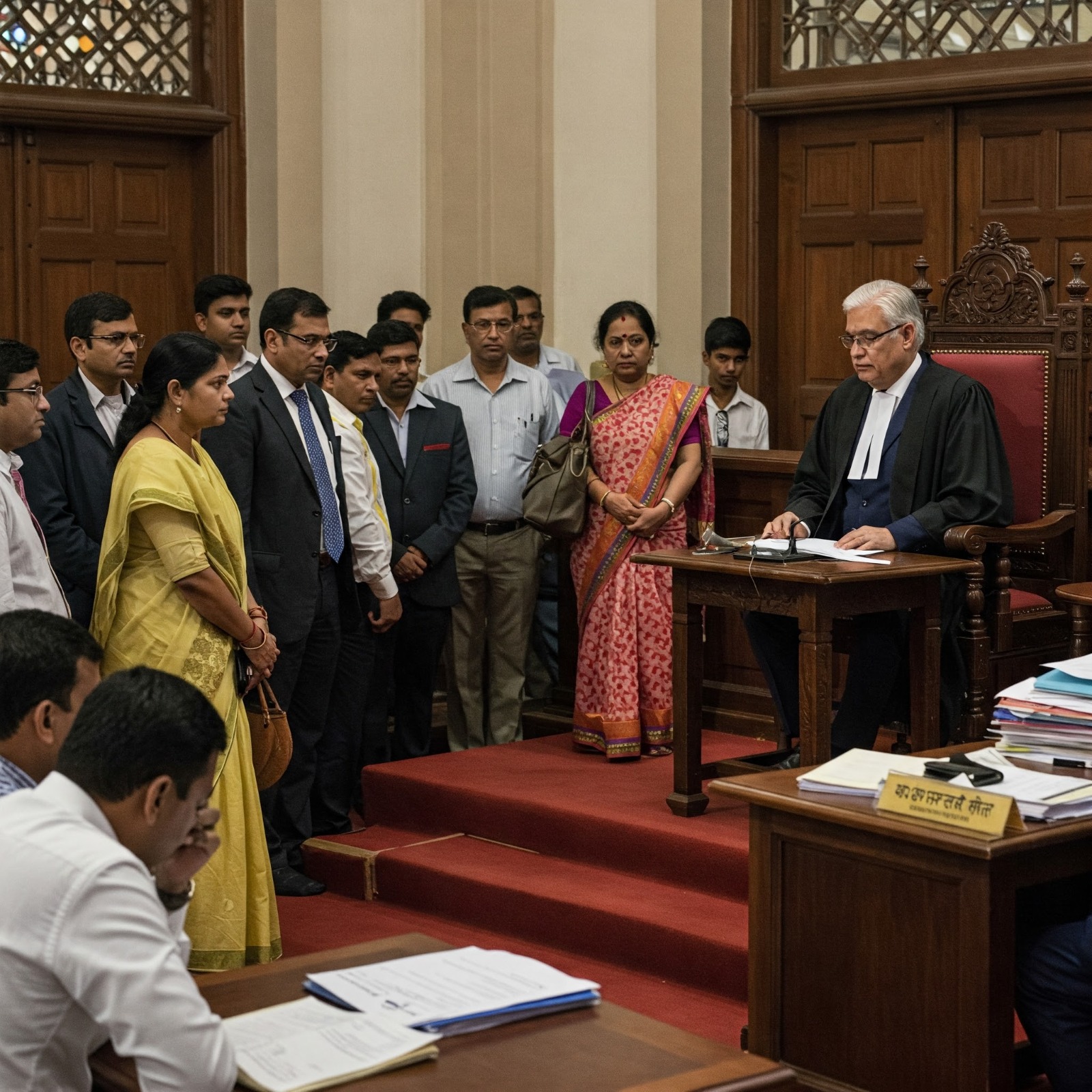
On Friday, February 28, the Supreme Court directed NCR states to compensate construction workers impacted by activity closures under the Graded Response Action Plan (GRAP) in Delhi-NCR.
A bench comprising Justices Abhay Oka and Ujjal Bhuyan emphasized that compensation must align with its earlier order from November 24, 2021, which required wages to be paid to affected workers using funds collected as labor cess.
The bench stressed that compensation must be provided even in the absence of a specific court order in the future. It reaffirmed that whenever construction activities are suspended due to GRAP measures, affected workers should receive subsistence payments in accordance with the court’s directives.
“As far as 2024 and 2025 are concerned we have issued directions to the state to pay compensation. We make it clear that hereafter whenever the construction activities are required to be closed due to implementation of GRAP measures, compensation shall be paid to the affected workers in terms of directions issued by this court dated 24th November 2021. Even if there is no specific direction of the court to pay compensation, the NCR States shall pay compensation”, the Court held.
During the proceedings, the court assessed the status of compensation payments in Delhi-NCR. Haryana reported that the final phase of payments was in progress. The court noted that compensation had been distributed to 2,68,759 workers during the first phase of GRAP 4 and 2,24,881 workers in the second phase. Additionally, payments for approximately 95,000 workers affected by the January 2025 GRAP 4 period are ongoing. Given this, the bench found no need for further directions to Haryana at this stage.
The Supreme Court reviewed the status of compensation payments in Delhi-NCR. In Delhi, an affidavit indicated that 93,272 workers had received compensation, while verification for the remaining registered workers was ongoing. The court permitted affected workers' unions to submit details to assist with verification and disbursement and directed the Delhi government to file an updated affidavit by March 2025 outlining the payments made.
For Rajasthan, the court recorded that compensation had been provided to 3,197 workers, requiring no further action. In Uttar Pradesh, authorities reported disbursing payments to 4,88,246, 4,84,157, and 691 workers affected during phases 1, 2, and 3 of GRAP, respectively, and the bench found no need for additional directions.
Addressing the scope of permitted activities under GRAP, the court referred to its November 24, 2021, order, which had banned construction in NCR while allowing non-polluting work such as plumbing, interior decoration, electrical tasks, and carpentry. It also mandated states to utilize labor cess funds to support construction workers and ensure wages were paid under the Minimum Wages Act during work suspensions. On Friday, counsel for the National Campaign Committee – Construction Labour urged the court to allow non-polluting construction activities even under GRAP 3 and GRAP 4 restrictions. However, the court declined, stating that the GRAP guidelines already define permissible activities.
The court added, “Learned counsel submits that directions issued in terms of clause 1 of order dated 24th November 2021 should continue to operate. However after the said order GRAP has undergone change. And therefore what will prevail is GRAP measures.”
Amicus curiae Aparajita Singh informed the bench that several authorities had failed to submit affidavits as directed on January 20, 2025. She suggested that the Commission for Air Quality Management (CAQM) be responsible for collecting and compiling the affidavits for the court’s review.
On January 20, the Court had issued notices to various authorities regarding vehicular pollution, including the Ministries of Road Transport and Highways, Housing and Urban Affairs, Heavy Industries, Petroleum and Natural Gas, and Environment, Forest and Climate Change. It also sought responses from the Chief Secretaries of Delhi, Haryana, Uttar Pradesh, and Rajasthan, as well as urban local bodies, town planning agencies, transport departments, and the Delhi Traffic Police.
On Friday, the court observed that only the Ministry of Road Transport and Highways (MoRTH) and the Ministry of Heavy Industries had submitted responses among central authorities, while Rajasthan, Delhi, and Haryana had complied at the state level. The court directed the Supreme Court Registry to issue fresh notices to non-compliant entities, requiring them to submit affidavits within one month. Additionally, those who had already responded were instructed to file improved affidavits. Modifying its January 20 order, the court mandated that all affidavits be sent to CAQM, which would compile them and provide copies to the amicus curiae.
 info@adhwaitha.com